


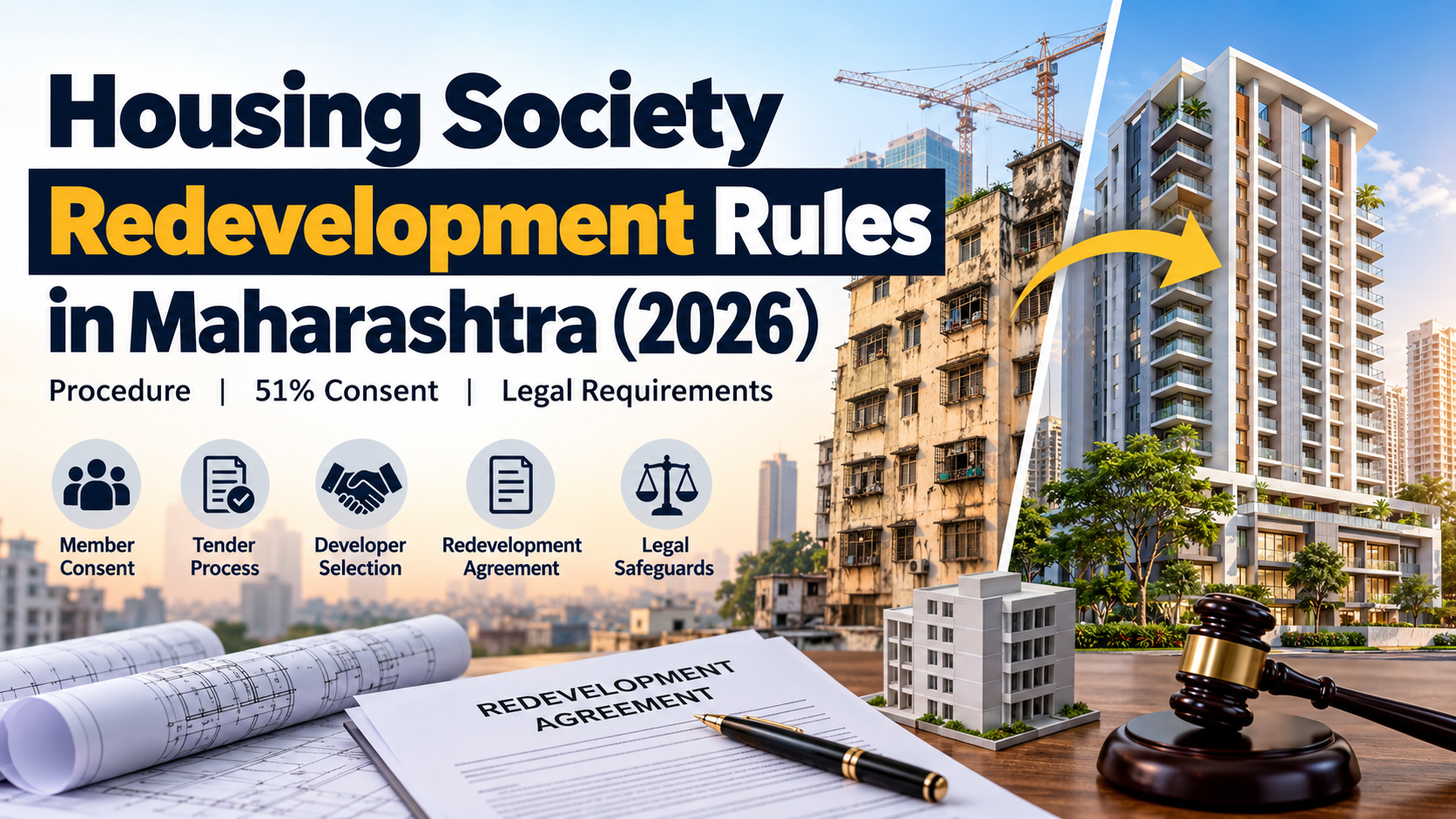
Housing Society Redevelopment Rules in Maharashtra: Procedure, 51% Consent and Legal Requirements
Introduction
Housing society redevelopment is an important legal and financial decision for members of old residential buildings in Maharashtra. Redevelopment may provide additional carpet area, improved amenities, modern construction, parking facilities and other benefits. However, the process can also lead to disputes regarding developer selection, members’ consent, transit rent, corpus funds, construction delays and the terms of the redevelopment agreement.
To protect members’ interests, a co-operative housing society must follow the applicable statutory provisions, government directions, registered bye-laws and development regulations.
An important recent development is the Maharashtra Government Order dated 30 September 2026, issued under Section 79A of the Maharashtra Co-operative Societies Act, 1960. Government Order No. SGRYO-2026/C.R.108/14-S revises the previous redevelopment procedure and supersedes the Government Resolution dated 4 July 2019 and the circulars issued under that earlier resolution.
The revised order introduces detailed procedural requirements concerning society meetings, members’ approval, appointment of a project management consultant, tendering, developer selection, transparency and execution of redevelopment agreements.
In this article, I explain the principal legal requirements and the precautions that housing society members and managing committees should take before proceeding with redevelopment.
1. Which laws govern housing society redevelopment in Maharashtra?
Housing society redevelopment is not governed by a single provision in isolation. The applicable legal framework may include the following:
1. Maharashtra Co-operative Societies Act, 1960: Section 79A provides the statutory basis for government directions of this nature concerning co-operative societies. Other provisions of the Act may also apply to the society’s administration and disputes.
2. Maharashtra Government Order dated 30 September 2026: This order sets out the revised procedure for redevelopment of co-operative housing society buildings.
3. Maharashtra Co-operative Societies Rules, 1961 and the society’s registered bye-laws: These are relevant to meetings, management, membership and other applicable procedural matters, subject to the governing statutory provisions and specific redevelopment directions.
4. Maharashtra Ownership Flats Act, 1963 (MOFA): Depending on the facts, provisions of MOFA may be relevant to the promoter’s obligations, conveyance and the legal status of the property.
5. Real Estate (Regulation and Development) Act, 2016 (RERA): Where applicable, RERA governs relevant promoter obligations, project registration and disclosures, including the carpet-area requirements addressed in redevelopment documentation.
6. Applicable development control regulations: Depending on the location and ownership of the land, relevant rules may include the applicable DCPR or UDCPR and requirements of authorities such as the municipal corporation, MHADA, CIDCO, SRA or MMRDA.
The society must identify the legislation and development regulations applicable to its particular property before approving a redevelopment proposal.
Official source: Maharashtra Government Order dated 30 September 2026 (PDF, Marathi).
2. When can a housing society undertake redevelopment?
The revised Government Order addresses redevelopment of buildings that have been declared by the competent authority to be dilapidated, ruinous or dangerous to inhabit, to persons passing nearby, or to neighbouring structures or places, provided the society is eligible for redevelopment under the applicable development control regulations.
Accordingly, the society should first examine the condition of the building, relevant technical reports, property documents, land ownership and the applicable planning regulations.
The revised order applies to different forms of redevelopment, including redevelopment through a developer, self-redevelopment, group redevelopment and redevelopment through a housing federation.
The precise eligibility and approval requirements must be checked against the property’s circumstances and the applicable development regulations.
3. Who can initiate the redevelopment process?
Under the revised procedure, at least one-fifth of the society’s members may submit a written application to the secretary requesting a special general meeting to consider the redevelopment policy. The application should include their proposals, plans and suggestions.
After receiving the application:
- The managing committee must take it on record at a committee meeting within eight days.
- The secretary must convene the special general meeting within two months of the application.
- The meeting notice and agenda must be served on every member at least 14 days in advance, and acknowledgements must be preserved.
- Before the meeting is called, the committee must obtain quotations from at least three eligible architects or project management consultants for preparation of the redevelopment project report.
The expert is selected through the special general meeting in accordance with the revised procedure.
The managing committee should maintain the application, committee minutes, quotations, meeting notice and service acknowledgements as part of the society’s official records.
4. What is the quorum for a redevelopment meeting?
The revised Government Order prescribes a quorum of two-thirds of the society’s total membership for the relevant special general meetings concerning redevelopment.
For example, if a society has 100 members, the quorum is 67 members because any fraction is rounded up to the next whole number.
The order permits attendance through video conference in specified circumstances, including members who are abroad, critically ill, disabled or unable to attend in person for unavoidable reasons. However, it also stipulates that at least 51% of the society’s total membership must be physically present.
If the required quorum is not achieved, the meeting must be adjourned and reconvened within one month after giving seven days’ notice. If the quorum again fails, the meeting is cancelled and the redevelopment proposal cannot be brought before another special general meeting for three months.
Members should not assume that the ordinary quorum provisions for routine society meetings automatically apply to redevelopment meetings.
5. Is 51% consent required for housing society redevelopment?
Yes. Under the revised Government Order dated 30 September 2026, the preliminary decision to undertake redevelopment requires approval of at least 51% of the society’s total membership.
The percentage is calculated against the total membership, not merely against the members attending the meeting.
For example, suppose a housing society has 100 members:
- Total membership: 100.
- Minimum quorum: 67 members.
- Minimum approval for the preliminary redevelopment decision: 51 members.
Even if 75 members attend, at least 51 members must approve the proposal.
Once the resolution is passed, the managing committee must obtain written consent letters from members who voted in favour before taking further redevelopment steps.
The developer-selection stage also has its own approval requirements under the revised order. The society must follow those requirements separately and should not treat approval of the initial redevelopment proposal as automatic authority to appoint a particular developer.
Members’ written consent should be genuine, properly recorded and consistent with the minutes and voting record.
6. Appointment of a Project Management Consultant (PMC)
After the preliminary redevelopment decision, the society must proceed with the selection and appointment of the architect or project management consultant in accordance with the revised procedure.
The consultant’s responsibilities include:
- Surveying the building and the land.
- Examining the position regarding conveyance of the land.
- Assessing the available FSI and TDR under the applicable development regulations.
- Considering members’ suggestions regarding residential area, commercial space, parking, open spaces, gardens and construction specifications.
- Preparing a realistic project report.
- Preparing separate reports and a comparative statement of the benefits available under different applicable development schemes, where relevant.
The appointed consultant must submit the project report to the managing committee within two months of appointment.
The society should also execute a written agreement with the consultant on the terms approved by the general body. Its scope should be sufficiently clear to avoid disputes about professional duties, deliverables, fees and responsibility for reviewing the redevelopment proposals.
7. Approval of the project report and invitation of tenders
Once the project report is received, the secretary must convene a managing committee meeting within 30 days.
Members must be informed about the meeting, and the project report must be made available for inspection at the society’s office. Members should receive an opportunity to submit their suggestions before the meeting.
The committee must consider those suggestions, consult the consultant and approve the project report in accordance with the prescribed procedure.
A draft tender document must then be prepared and placed before a special general meeting for approval.
An important requirement is that the tender should keep either the offered carpet area or the corpus fund constant so that competing developers’ offers can be compared on a consistent basis.
After approval of the tender document, invitations for tenders must be published through public notices in Marathi and English newspapers having the highest local circulation, as specified in the Government Order.
The society may also invite tenders from reputed and experienced developers known to its members.
8. How should society evaluate developers?
Developer selection should be based on documented criteria rather than personal relationships or informal assurances.
The revised order contemplates obtaining at least three competitive tenders. If fewer than three tenders are received, the society must first grant an extension of at least 15 days and, if necessary, a second extension of one week. If fewer than three tenders are still received, the tenders available may be placed before the special general meeting in accordance with the order.
The tenders are opened in the presence of those attending the relevant meeting. The architect or PMC scrutinises them and prepares a comparative statement addressing matters such as:
- The developer’s experience and reputation.
- Financial capacity.
- Technical capability.
- Quality of previous work.
- Proposed carpet area and other member benefits.
- Transit rent or alternative accommodation.
- Corpus and other financial terms.
- Construction timelines and proposed security.
The society should not select a developer solely because it promises the largest additional carpet area or the highest corpus fund. The committee must also examine the developer’s capacity to complete the project and honour the contractual commitments.
Members should receive sufficient information to make an informed decision.
9. Is the Registrar’s representative required during developer selection?
Yes. Under the revised 30 September 2026 Government Order, the special general meeting for selecting the developer must be conducted in the presence of an authorised officer appointed through the Registrar’s office.
Before the meeting, the society must submit the prescribed proposal and documents, including the relevant meeting minutes, list of members, project report, tender information and comparative statement.
The Registrar must decide on the appointment of the authorised officer within 14 days of receiving the proposal. Following appointment, the secretary must convene the developer-selection meeting within one month and send the agenda and comparative tender statement to members at least 14 days in advance.
The authorised officer verifies attendance, identity and quorum. The selection meeting must also be video-recorded at the society’s expense.
Members must be given an opportunity to express their views and record objections. Voting is ordinarily by a show of hands, but a secret ballot must be arranged where at least one-fifth of the total membership makes the required written demand.
Approval of the developer requires written consent or approval from at least 51% of the total membership present physically or through permitted video-conference attendance, subject to the order’s separate requirement concerning physical attendance. Consent from absent members is not counted.
The minutes, written approval letters, developer’s consent letter and attendance sheet must be submitted to the Registrar’s office within 14 days. The authorised officer must also submit the prescribed report and video record.
These requirements are important safeguards against an arbitrary or inadequately documented developer appointment.
10. Important clauses in a redevelopment agreement
The registered development agreement is one of the most important documents in a society redevelopment project. A poorly drafted agreement can create serious disputes concerning additional area, rent, delays, construction quality and the developer’s obligations.
The revised Government Order requires the agreement to incorporate specified matters, including the following.
Carpet area and member entitlements
The agreement should clearly state the carpet area promised to each member in accordance with applicable RERA requirements. The precise entitlement, treatment of existing area and additional benefits should be unambiguous.
Promises made in presentations or informal letters should not replace enforceable contractual terms.
Construction timeline
The order specifies a completion period of two years, with an exceptional extension up to three years, from the prescribed initial or foundation-certificate milestone described in the order. The agreement should identify the applicable commencement milestone, completion date and contractual consequences of delay.
The timeline must also be read alongside applicable planning approvals and the project’s specific legal circumstances.
Bank guarantee
The form and proportion of the bank guarantee are to be decided with the general body’s approval. The agreement should specify the amount, validity, invocation conditions, renewal obligations and consequences of non-compliance.
The society should obtain legal and financial advice before approving the security structure.
Transit rent and temporary accommodation
The agreement should expressly provide for temporary accommodation or an appropriate arrangement for monthly rent and deposit, or transit accommodation, as contemplated by the revised order.
The amount, payment dates, escalation where negotiated, deposit obligations and consequences of delayed payment should be recorded clearly.
Registration of agreements
The development agreement between the society and the developer must be registered. The Permanent Alternative Accommodation Agreement (PAAA) with each member must also be registered.
The revised order requires the individual PAAA to be executed within three months after registration of the development agreement.
Transfer of development rights
The order states that development rights granted to the selected developer are non-transferable.
The society should ensure that the agreement and associated documents are consistent with this requirement and do not permit an unauthorised transfer of the project.
Disputes and remedies
The agreement should provide for disputes to be taken to the competent court or authority under the applicable law. It should also address construction defects, delay, default, termination where legally permissible, and enforcement of security.
The society should have the draft development agreement and PAAA reviewed before execution.
11. When can members vacate their flats?
Members should not vacate their existing flats merely because a developer has been selected or a general body resolution has been passed.
The revised Government Order states that members should vacate only after the required legal approvals for redevelopment have been obtained and their individual Permanent Alternative Accommodation Agreements have been registered.
The society should verify compliance with these requirements and review the actual contractual arrangements before asking members to hand over possession.
The agreement should also record the conditions for handing over vacant possession, payment of rent or deposit, the developer’s obligations and the consequences of any delay in the project.
Members should keep copies of the registered PAAA, possession-related documents, payment records and correspondence.
12. Can society undertake self-redevelopment?
Yes. The revised Government Order expressly addresses self-redevelopment as well as redevelopment through a developer.
The prescribed developer-appointment procedure applies correspondingly to selection of a contractor for self-redevelopment.
However, self-development requires careful planning of construction finance, consultant appointments, approvals, tendering, procurement, cash flow, construction contracts and project management.
The managing committee should obtain an independent feasibility study before recommending this option. It must also ensure that the society has adequate financial resources and appropriate contractual safeguards.
Self-development is not automatically less risky or more profitable than appointing a developer.
13. Can a single member stop housing society redevelopment?
A single member’s objection does not automatically invalidate a redevelopment proposal that has been lawfully approved and processed. However, an affected member may have grounds to challenge a decision where there is a material violation of the applicable law or Government Order, an improper meeting, defective voting, fraud, breach of contractual rights or another legally recognised ground.
The appropriate remedy depends on the dispute, the documents involved, the stage of redevelopment and the competent forum.
A member who objects should preserve the meeting notice, attendance details, minutes, voting records, consent documents, tender papers and correspondence. Any legal challenge should identify the specific alleged irregularity and the relief sought.
Equally, managing committee members should not assume that majority approval permits them to disregard mandatory procedure or individual contractual rights.
14. Can the managing committee appoint a developer without following the prescribed tender process?
The managing committee must follow the procedure applicable under the revised Government Order, including the requirements regarding the project report, tendering, comparative evaluation and developer-selection meeting.
Informal negotiations or an agreement with a preferred developer should not be treated as a substitute for the required process.
The revised order also states that a managing committee member or office-bearer cannot be the developer or a relative of the developer. Any actual or potential conflict of interest should be carefully examined and documented.
Where serious irregularities are alleged, members should obtain the relevant records and seek appropriate legal advice rather than relying on verbal assurances.
15. Transparency and inspection of redevelopment documents
Transparency is a major feature of the revised procedure.
Redevelopment-related documents, including meeting notices, minutes, general body video recordings, the PMC’s report, tender documents, tenders, comparative statements and the draft development agreement, must be made available to members for inspection free of charge.
Copies are to be provided promptly upon payment of the prescribed fee. The secretary is responsible for providing the documents in accordance with the order.
The managing committee must also communicate redevelopment meeting notices and minutes to the concerned Registrar’s office within 14 days of the relevant meeting and retain acknowledgements.
Once the competent municipal or planning authority has approved the building plans, those plans must be presented before the general body for information.
Members should exercise their inspection rights and retain copies of significant documents.
16. What happens after redevelopment is completed?
The revised order provides for a transparent process for allotting flats in the redeveloped building.
A special general meeting must be convened after giving members at least 14 days’ notice. Allotment should, where feasible, follow the existing floor position; where a lottery is necessary, the prescribed lottery procedure must be followed.
The flat-allotment meeting must be video-recorded. The meeting minutes, video record and certified allotment list must be submitted to the Registrar’s office within one month.
The managing committee is also responsible for taking a decision on membership applications of new flat or unit holders and issuing membership and share certificates within three months after possession, as provided in the order.
The society should maintain updated membership records and ensure that the final allotment and possession documents are consistent with the registered agreements and sanctioned plans.
Frequently Asked Questions (FAQs)
1. What is the latest Government Order for housing society redevelopment in Maharashtra?
The revised order is Government Order No. SGRYO-2026/C.R.108/14-S dated 30 September 2026, issued under Section 79A of the Maharashtra Co-operative Societies Act, 1960. It supersedes the earlier redevelopment Government Resolution dated 4 July 2019 and the circulars issued under it.
2. What is the quorum for a housing society redevelopment meeting?
The revised order prescribes a quorum of two-thirds of the total membership for the relevant special general meetings. Fractions are rounded up to the next whole number.
3. Is approval from 51% of all members required?
Yes. The revised order requires approval from at least 51% of the society’s total membership for the preliminary redevelopment decision and separately prescribes approval requirements for selecting a developer.
4. Is a PMC compulsory for redevelopment?
The revised procedure provides for selection of an eligible architect or project management consultant to prepare the project report and assist in the redevelopment process. The society must comply with the applicable selection requirements.
5. Must the redevelopment agreement be registered?
Yes. The revised Government Order requires registration of the development agreement and the individual Permanent Alternative Accommodation Agreements.
6. Can the developer transfer the redevelopment project to another developer?
The revised order states that the development rights granted to the selected developer are non-transferable. The agreement should be examined in light of that requirement and other applicable legal provisions.
7. Can a society proceed with self-redevelopment?
Yes. Self-development is covered by the revised order, which applies the developer-selection procedure when appointing a contractor.
8. Where can a member complain about illegal redevelopment?
The appropriate forum depends on the type of violation and the relief required. Depending on the facts, a member may need to approach the Registrar or another competent statutory authority, a court or another legally appropriate forum. The member should first identify the specific violation and collect the supporting documents.
Conclusion
Housing society redevelopment in Maharashtra requires careful compliance with the applicable legal framework and the Government Order dated 30 September 2026.
The revised procedure places particular emphasis on a properly elected managing committee, participation of members, the two-thirds quorum, the 51% approval requirement, transparent tendering, supervised developer selection, video-recorded meetings and registered redevelopment agreements.
For members, the most important precautions are to verify the actual carpet-area entitlement, transit rent, bank guarantee, completion timeline and contractual safeguards before agreeing to vacate their flats.
For managing committees, maintaining complete records and following every applicable procedural requirement is essential to reduce disputes and protect the society’s interests.
Legal disclaimer: This article provides general legal information about Maharashtra housing society redevelopment. It is not a substitute for advice on a particular property, society or redevelopment agreement. The applicable law, Government Order, sanctioned development regulations, land ownership documents and project-specific circumstances should be verified before taking legal action.