


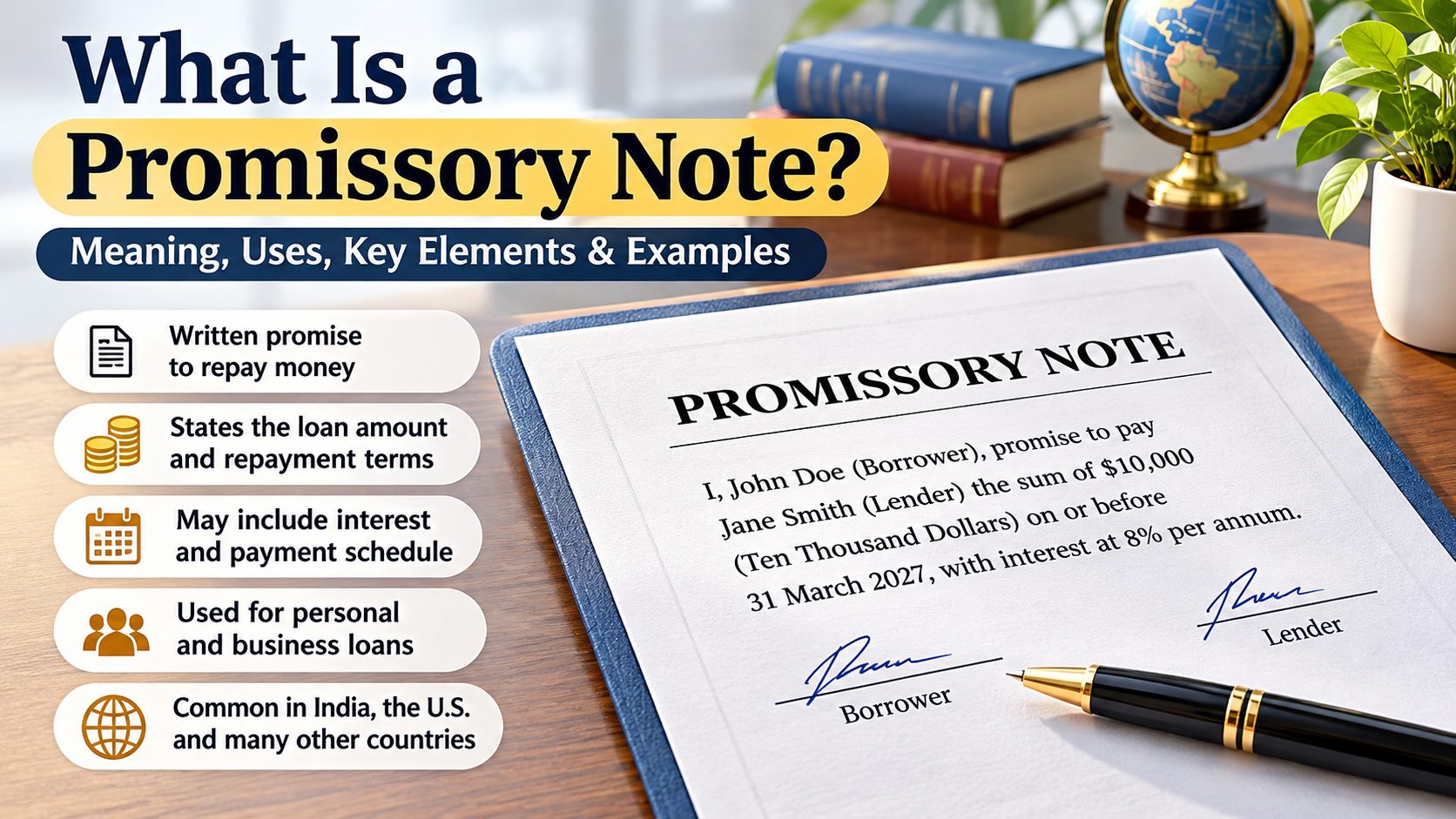
What Is a Promissory Note? Meaning, Uses, Examples and Key Elements
What Is a Promissory Note?
A promissory note is a written document in which one person promises to repay a specific amount of money to another person, either on demand or according to agreed repayment terms. It generally identifies the borrower, the lender, the amount borrowed, and the conditions for repayment. Depending on the arrangement, it may also include interest, instalment dates, a final payment deadline, and signatures. It provides a written record of a financial obligation and helps both parties understand their responsibilities.
What Does a Promissory Note Mean?
The meaning of a promissory note is straightforward: it records a person’s commitment to pay money to another person or an identified recipient.
The person who promises to repay the money is commonly called the maker or borrower. The person entitled to receive the payment is commonly called the payee or lender.
For example, suppose Rahul borrows ₹1,00,000 from Amit to meet a personal expense. Rahul signs a document acknowledging the amount and promising to repay it within six months. That document may serve as a promissory note if it satisfies the applicable requirements.
Promissory notes can be used for personal borrowing, business transactions, short-term financing, and other arrangements where a written promise to repay money is appropriate.
What Are the Main Elements of a Promissory Note?
A well-prepared promissory note should clearly explain the financial arrangement. Its essential contents generally include the following:
1. Names of the Parties
Include the full names and identifying details of the borrower and the lender. Their addresses may also be recorded to help distinguish the parties and maintain accurate records.
2. Principal Amount
State the amount borrowed in numbers and words. For international transactions, specify the currency, such as Indian rupees (INR), US dollars (USD), or another agreed currency.
3. Promise to Repay
Use clear language expressing the borrower’s commitment to pay the stated amount. The wording should not leave uncertainty about whether repayment is actually promised.
4. Interest, If Applicable
Specify whether interest will be charged. If applicable, clearly state the rate, whether it is calculated on a simple or compound basis, and how it will be calculated.
If the loan is interest-free, state that expressly.
5. Repayment Schedule
Explain when and how the borrower must repay the money. Repayment may be due on a specified date, through monthly instalments, or on demand, depending on the arrangement and applicable requirements.
6. Date and Place of Execution
Include the date on which the document is signed and, where relevant, the place of execution.
7. Signatures
The borrower should sign the document. The lender’s signature, witness details, or other formalities may be appropriate or required depending on the transaction and the jurisdiction.
8. Additional Repayment Conditions
Where appropriate, explain how payments will be made, how partial repayments will be recorded, and what happens if a payment is missed.
The terms should be clear, consistent, and agreed upon before the document is signed.
How Does a Promissory Note Work?
A promissory note records the repayment promise and provides a reference for both parties throughout the transaction.
A typical process works as follows:
- Agree on the loan: The borrower and lender decide the amount, purpose, interest, and repayment conditions.
- Prepare a document: The agreed terms are written clearly, including the identities of the parties and the repayment schedule.
- Review the terms: Both parties should check the amount, dates, interest calculation, and other conditions for accuracy.
- Sign the note: The parties complete the appropriate signing formalities for their transaction.
- Transfer of money: The lender provides the agreed funds and retains proof of payment.
- Record repayments: Each payment is documented, and the outstanding balance is updated until the debt is repaid.
A promissory note does not, of itself, prove that money was transferred in every situation. Keeping bank records, receipts, and payment confirmations can help establish the details of the transaction.
Promissory Note Example
Consider the following illustrative example.
Priya lends David $5,000 for a personal expense. They agree that David will repay the principal in five monthly instalments of $1,000, beginning on 1 December 2026. They decided that no interest would be charged.
Their written promissory note could record:
- Borrower: David
- Lender: Priya
- Principal amount: $5,000
- Interest: None
- Repayment: Five monthly instalments of $1,000
- First payment date: 1 December 2026
- Final payment date: 1 April 2027
- Signature: David, as the person promising repayment
This example illustrates the basic structure. A real document should include the complete payment dates, the parties’ details, appropriate signing formalities, and any additional terms needed for the particular arrangement.
What Are the Different Types of Promissory Notes?
Promissory notes may be structured differently depending on the transaction.
Demand Promissory Note
A demand note provides for repayment when the lender requests payment, subject to the agreed terms and applicable requirements.
Fixed-Date Promissory Note
This type specifies a particular date by which the borrower must repay the amount.
Instalment Promissory Note
An instalment note sets out a series of payments rather than requiring the entire amount to be repaid at once.
Interest-Bearing Promissory Note
This document provides for interest on the outstanding principal according to an agreed calculation method.
Interest-Free Promissory Note
An interest-free note records a repayment obligation without charging interest on the principal.
The following descriptions explain common repayment structures. The appropriate format and enforceability of a particular note can vary by country and transaction.
What Is the Difference Between a Promissory Note and a Loan Agreement?
Although both documents can record borrowing arrangements, they serve different practical purposes.
| Features | Promissory Note | Loan Agreement |
|---|---|---|
| Main purpose | Records a promise to repay money | Sets out the broader terms of a loan |
| Typical contents | Amount, repayment promise, due date and interest | Loan purpose, disbursement, repayment, representations and other conditions |
| Complexity | Often relatively short | Maybe a more detailed |
| Parties’ obligations | Focuses primarily on the repayment promise | Can describe obligations of both borrower and lender |
| Suitable use | Straightforward borrowing arrangements | Transactions requiring more detailed terms |
The documents may overlap, and a promissory note can accompany a loan agreement. The appropriate choice depends on the transaction’s complexity and the requirements of the relevant jurisdiction.
Why Is a Promissory Note Important?
A promissory note can help both parties by:
- Creating a written record: This documents the amount owed and the repayment commitment.
- Reducing misunderstandings: Clear terms help prevent disputes about payment dates, interest, and outstanding balances.
- Supporting financial records: It can be retained with bank statements, receipts, and repayment records.
- Clarifying responsibilities: Both parties can refer to the agreed conditions throughout the loan.
- Assisting dispute resolution: A properly prepared note may provide useful evidence of the recorded arrangement, although its effect depends on the circumstances.
A promissory note cannot eliminate every risk. Its usefulness depends on the clarity of its terms, the authenticity of the signatures, the underlying transaction, and compliance with applicable requirements.
How to Write a Promissory Note
Before preparing a promissory note, consider the following practical steps:
- Identify the parties accurately. Use their complete names and appropriate identifying details.
- State the amount and currency. Ensure that the written and numerical amounts match.
- Define repayment terms. Specify whether repayment is due on demand, on a fixed date, or through instalments.
- Explain your interest clearly. Include the rate and calculation method, or state that no interest is payable.
- Address missed payments. Where appropriate, explain the consequences of late payment and any agreed procedure for resolving payment difficulties.
- Check the signing requirements. Confirm whether witnesses, particular formalities, or other documentation is needed.
- Retain supporting records. Keep a signed copy as evidence of the loan disbursement and subsequent payments.
Avoid vague phrases such as “repayment will be made soon.” Specific dates and measurable obligations are easier to understand and administer.
What Should You Check Before Signing a Promissory Note?
Before signing, the borrower and lender should confirm that:
- The principal amount is correct.
- The repayment schedule is realistic and clearly stated.
- Interest and additional charges are accurately described.
- The parties’ names and details are correct.
- There are no blank spaces that could later be filled with different terms.
- The document reflects the actual agreement between the parties.
- Each party receives and retains an appropriate copy.
For a large loan, cross-border transaction, or arrangement involving substantial financial risk, obtaining professional advice before signing can help prevent avoidable problems.
Is a Promissory Note Valid in Every Country?
A promissory note is used in many countries, including India and the United States, as well as in international commercial transactions. However, the requirements for preparing, signing, and enforcing a promissory note are not identical everywhere.
Differences may concern the wording of the promise, signature requirements, applicable formalities, interest restrictions, transferability, and the procedures available when repayment is not made.
A document suitable for a straightforward transaction in one country may require changes before it can be used elsewhere. There is no single universal format that automatically satisfies every country’s requirements.
Before using a promissory note internationally, identify the relevant jurisdiction and confirm that the document is appropriate for the transaction.
Conclusion
A promissory note is a practical way to record a promise to repay borrowed money. It typically identifies the borrower and lender, states the principal amount, and explains the repayment terms. Depending on the arrangement, it may also include interest, instalment dates, and additional conditions.
Whether you are lending money to a friend, borrowing funds for personal expenses, or documenting a business transaction, clear wording and accurate records are essential. Choose a format suited to the transaction, review every term before signing, and confirm the applicable requirements in the relevant country.
Legal Information Disclaimer: This article is provided for general informational and educational purposes only. It is not legal, financial, or professional advice and does not create an attorney-client relationship. Requirements and outcomes may vary depending on the country, jurisdiction, and circumstances of the transaction. Readers should obtain appropriate professional advice before preparing, signing, or relying on a promissory note.