


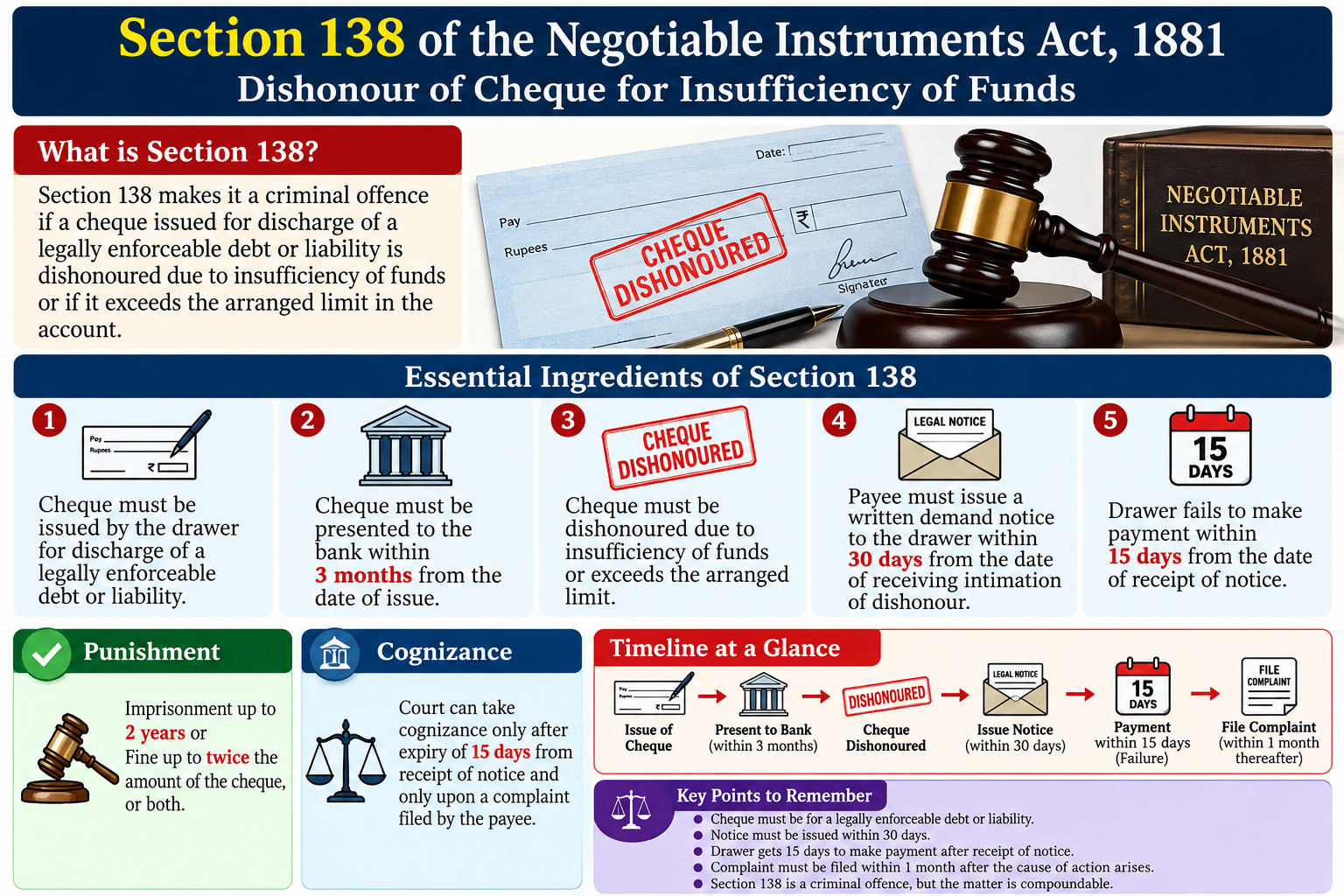
Section 138 of the Negotiable Instruments Act, 1881: Complete Guide to Cheque Bounce, Legal Notice, Procedure and Punishment
Cheques are commonly used in India for business and personal transactions. But what happens when a cheque is presented to the bank and is returned unpaid because there are insufficient funds in the drawer’s account?
A cheque bounce is not merely a banking inconvenience. In certain circumstances, it can give rise to criminal liability under Section 138 of the Negotiable Instruments Act, 1881.
Section 138 provides a legal remedy to a payee or holder in due course when a cheque issued towards a legally enforceable debt or liability is dishonoured for specified reasons.
This article explains Section 138 of the Negotiable Instruments Act in simple language, including its essential ingredients, legal notice, statutory timelines, filing of a complaint, punishment, common defences, interim compensation, settlement and other important practical aspects.
Important: The timelines under Section 138 are strict. A mistake in calculating the notice period, payment period or limitation period can seriously affect the maintainability of a complaint.
What Is Section 138 of the Negotiable Instruments Act, 1881?
Section 138 of the Negotiable Instruments Act, 1881 deals with the dishonour of a cheque for insufficiency of funds or exceeding the arrangement made with the bank.
Where a person issues a cheque for the discharge, wholly or partly, of a legally enforceable debt or liability, and the cheque is returned unpaid for the reasons covered by Section 138, the drawer may be prosecuted, subject to fulfilment of the statutory conditions.
In simple words:
Debt or liability → Cheque issued → Cheque dishonoured → Legal notice → 15 days to pay → Non-payment → Section 138 complaint
The provision is intended to protect the credibility and reliability of cheques as a method of payment.
Why Was Section 138 Introduced?
Cheques are widely used because the person receiving a cheque expects that it represents a genuine payment.
If cheques could be issued without sufficient funds and there were no meaningful consequences, confidence in cheque-based transactions would be affected.
Section 138 was introduced to strengthen the credibility of negotiable instruments and provide a statutory remedy where a cheque issued towards a legally enforceable debt or liability is dishonoured.
Important Terms Under Section 138
Before understanding the procedure, it is useful to understand the parties involved.
1. Drawer
The drawer is the person who issues and signs the cheque.
2. Payee
The payee is the person in whose favour the cheque has been issued.
3. Drawee Bank
The drawee bank is the bank on which the cheque is drawn.
4. Holder in Due Course
A holder in due course is a person who obtains the cheque for consideration and in good faith, subject to the requirements of the Negotiable Instruments Act.
These terms are important because a Section 138 complaint is generally instituted by the payee or holder in due course against the drawer.
Essential Ingredients of Section 138
For a Section 138 complaint to succeed, the statutory requirements must be satisfied.
The important ingredients include:
- A cheque must have been drawn by the accused on an account maintained by him or her with a bank.
- The cheque must have been issued towards the discharge, wholly or partly, of a legally enforceable debt or other liability.
- The cheque must be presented within the applicable period of validity.
- The cheque must be returned unpaid for insufficiency of funds or because the amount exceeds the arrangement made with the bank.
- The payee or holder in due course must issue a written demand notice within 30 days from receiving information regarding the dishonour from the bank.
- The drawer must fail to make payment of the cheque amount within 15 days of receiving the notice.
If these statutory requirements are not properly complied with, the complaint may face serious legal difficulties.
What If the Cheque Is Dishonoured for Another Reason?
Section 138 specifically refers to insufficiency of funds and exceeding the arrangement with the bank.
However, cheque dishonour cases may also involve reasons such as:
- Payment stopped by drawer
- Account closed
- Signature differs
- Stale cheque
- Other banking return reasons
The legal consequences can depend upon the particular facts and circumstances of the case. Therefore, the exact reason mentioned in the bank return memo should be carefully examined before issuing a notice or filing a complaint.
Does Section 138 Apply to a Gift?
Generally, the cheque must relate to a legally enforceable debt or liability.
Therefore, a cheque issued purely as a gift, without an underlying legally enforceable liability, would not ordinarily satisfy this essential requirement.
The nature of the underlying transaction is therefore extremely important in a Section 138 proceeding.
Punishment Under Section 138
If the accused is convicted under Section 138, the court may impose:
- Imprisonment up to two years, or
- Fine up to twice the amount of the cheque, or
- Both.
The court may also award compensation to the complainant in accordance with law.
Is a Section 138 Offence Bailable and Compoundable?
A Section 138 offence is generally treated as:
- Bailable
- Non-cognizable
- Compoundable
A Section 138 case normally proceeds through a complaint before the competent Magistrate rather than through registration of an FIR by the police.
The offence can also be settled between the parties, subject to the applicable law and orders of the court.
Can a Civil Suit and Section 138 Complaint Be Filed Together?
Yes, the criminal remedy under Section 138 and a civil remedy for recovery of money are distinct remedies.
Depending upon the facts, a payee may pursue a Section 138 complaint as well as a civil proceeding for recovery of the amount.
For example, a civil recovery proceeding, including a summary suit where legally maintainable, may be considered separately from the cheque dishonour complaint.
The two proceedings should, however, be strategically handled after considering the facts of the transaction and the reliefs already claimed.
Step-by-Step Procedure Under Section 138
Step 1: Present the Cheque Within Its Validity
The cheque should be presented within the applicable validity period.
The date appearing on the cheque is therefore important, and the payee should not unnecessarily delay its presentation.
A cheque may be presented more than once during its validity period, subject to the facts and applicable law.
Step 2: Obtain the Bank Return Memo
If the cheque is dishonoured, the bank normally issues a cheque return memo mentioning the reason for dishonour.
The following documents should be preserved carefully:
- Original cheque
- Bank return memo
- Bank statement or relevant banking record
- Documents relating to the underlying transaction
The cheque and return memo are particularly important documents in a Section 138 proceeding.
Step 3: Issue a Legal Notice Within 30 Days
After receiving information from the bank regarding dishonour, the payee must issue a written demand notice within 30 days.
The notice should clearly demand payment of the cheque amount.
What Should a Section 138 Legal Notice Contain?
A properly drafted notice should generally mention:
- Name and address of the drawer
- Name and address of the payee
- Cheque number
- Cheque date
- Cheque amount
- Name of the bank and branch
- Date of presentation
- Date of dishonour
- Reason for dishonour
- Details of the legally enforceable debt or liability
- Demand for payment of the cheque amount
- 15-day statutory payment period
- Consequences of failure to make payment
The notice should clearly communicate that failure to make payment within the statutory period may result in appropriate proceedings under the Negotiable Instruments Act.
How Should the Legal Notice Be Sent?
The notice should be sent to the correct and last-known address of the drawer.
Common methods include:
- Registered Post A.D.
- Speed Post
- Courier, where appropriate
- Other legally recognised modes of service
- Email as an additional mode of communication
Postal receipts, tracking reports, delivery records and returned envelopes should be preserved.
The objective is to maintain reliable evidence showing that the statutory notice was properly addressed and dispatched.
Can Interest and Legal Expenses Be Claimed in the Notice?
If interest, legal expenses or other amounts are claimed, the notice should clearly distinguish those amounts from the cheque amount.
The statutory demand relating to the cheque amount should be clear and unambiguous.
A poorly drafted notice may create unnecessary disputes regarding whether the statutory demand was properly made.
Step 4: Wait for 15 Days
After receiving the statutory notice, the drawer gets 15 days to make payment of the cheque amount.
If the drawer makes the required payment within the statutory period, the foundation for a Section 138 prosecution arising from that dishonour does not proceed in the ordinary manner.
If payment is not made within the 15-day period, the cause of action arises after expiry of the statutory period.
Step 5: File the Section 138 Complaint Within One Month
After the cause of action arises, the complaint should ordinarily be filed within one month in accordance with Section 142 of the Negotiable Instruments Act.
A court may condone delay where sufficient cause is shown, but limitation should never be taken casually.
Who Can File the Complaint?
The complaint may be filed by:
- The payee; or
- The holder in due course.
In the case of a company, the complaint is filed through an authorised person in accordance with law.
Territorial Jurisdiction in Section 138 Cases
Territorial jurisdiction in cheque dishonour matters is governed by the provisions of the Negotiable Instruments Act and the applicable judicial interpretation.
After the statutory changes relating to jurisdiction, where the cheque is delivered for collection through an account, jurisdiction may lie with the court having jurisdiction over the branch of the payee’s bank where the account is maintained.
The precise jurisdiction should always be checked from the facts of the transaction and the manner in which the cheque was presented.
Documents Required for a Section 138 Complaint
Important documents may include:
- Original cheque
- Original bank return memo
- Copy of legal notice
- Postal receipt
- Tracking report or delivery proof
- Documents establishing the underlying debt or liability
- Agreement, invoice, ledger, loan document, receipt or other transaction records
- Relevant correspondence or messages
- Affidavit of evidence, wherever applicable
- Authorisation documents in case of a company or representative
The exact documents will depend upon the nature of the underlying transaction.
Step 6: Verification, Cognizance and Summons
After the complaint is filed, the Magistrate considers the complaint and supporting material.
If the court finds sufficient grounds to proceed, it may take cognizance and issue summons to the accused.
The complainant should therefore ensure that the complaint is properly drafted and supported by relevant documents.
Step 7: Appearance, Bail and Plea
After receiving the summons, the accused appears before the court.
The court deals with the accused’s appearance, bail and plea in accordance with the applicable procedure.
The accused is entitled to contest the allegations and raise legally available defences.
Interim Compensation Under Section 143A
Section 143A provides for interim compensation of up to 20% of the cheque amount, subject to the statutory conditions and judicial discretion.
The provision is intended to provide some monetary relief to the complainant during the pendency of the proceedings.
The court must consider the circumstances of the case while exercising the power under this provision.
Step 8: Trial of the Section 138 Case
Section 143 provides for summary trial of cheque dishonour cases, subject to the statutory framework.
In practice, the proceedings may involve:
Complainant’s Evidence
The complainant may give evidence by affidavit and produce the relevant documents.
Cross-Examination
The accused has the right to cross-examine the complainant where permitted and applicable.
Bank Return Memo
Section 146 provides a statutory evidentiary mechanism relating to the bank’s return memo.
Statement of Accused
The court records the accused’s statement regarding the incriminating circumstances.
Defence Evidence
The accused may lead defence evidence where the accused chooses to do so.
The actual duration of a case can vary considerably depending on the court, the number of hearings, service of summons and the conduct of the parties.
Step 9: Judgment
After completion of evidence and arguments, the court delivers its judgment.
If the accused is convicted, the court may impose punishment and may also order payment of compensation in accordance with law.
If the accused is acquitted, the complainant may have an appropriate appellate remedy subject to the applicable statutory requirements.
Step 10: Appeal and Deposit Requirement
Section 148 of the Negotiable Instruments Act contains provisions relating to deposit during an appeal against conviction.
The appellate court may direct the appellant to deposit an amount in accordance with the statutory provision, including the prescribed minimum where applicable.
Therefore, an accused convicted under Section 138 should obtain proper legal advice before filing an appeal.
Presumptions Under Sections 118 and 139
One of the important features of cheque dishonour litigation is the statutory presumptions in favour of the holder.
Section 118
The Negotiable Instruments Act contains presumptions relating to consideration and other matters.
Section 139
Section 139 provides a presumption in favour of the holder that the cheque was received for the discharge, wholly or partly, of a debt or other liability.
These presumptions are rebuttable.
The accused may raise a probable defence and rebut the statutory presumption on the applicable standard of proof.
Section 140 of the Negotiable Instruments Act
Section 140 restricts certain defences relating to lack of reason to believe that the cheque would be dishonoured.
The accused cannot simply rely on the argument that he or she did not expect the cheque to be dishonoured where the statutory provision otherwise applies.
Common Defences in Section 138 Cases
Depending upon the facts, an accused may raise several possible defences, including:
- There was no legally enforceable debt or liability.
- The alleged debt was not legally recoverable.
- The cheque was issued as security, and the underlying liability had not matured.
- Payment had already been made.
- The cheque was lost or stolen.
- The cheque was forged or misused.
- The statutory notice was not issued within the prescribed period.
- The complaint was filed beyond the limitation period.
- Payment was made within the statutory 15-day period.
- The court lacks territorial jurisdiction.
- The transaction relied upon by the complainant is disputed.
A security cheque does not automatically mean that Section 138 can never apply. The important question is whether a legally enforceable liability existed when the cheque was presented.
Therefore, the defence must always be examined on the facts and documents of the particular case.
Section 138 and Company Cheques
When a cheque issued by a company is dishonoured, Section 141 becomes important.
Depending upon the statutory requirements, the company and persons who were in charge of and responsible for the conduct of its business at the relevant time may be prosecuted.
The complaint should contain appropriate factual averments explaining the role and responsibility of the concerned person.
A person cannot necessarily be made criminally liable merely because that person holds the designation of director.
The actual role and responsibility of the concerned individual must be considered.
Can a Section 138 Case Be Settled?
Yes.
Under Section 147 of the Negotiable Instruments Act, offences under the Act are compoundable.
The parties can settle the dispute, subject to the applicable procedure and orders of the court.
Settlement can take place at different stages of the proceedings.
Where a matter is settled at a later stage, the court may consider costs in accordance with applicable judicial guidelines.
Important Recent Legal Developments
Cheque dishonour litigation must be considered along with the changes in India’s criminal procedure and evidence laws.
The Bharatiya Nagarik Suraksha Sanhita, 2023 (BNSS) has replaced the Code of Criminal Procedure framework, while the Bharatiya Sakshya Adhiniyam, 2023 (BSA) governs evidence.
Older judgments may therefore contain references to provisions of the CrPC and Indian Evidence Act.
Advocates should verify the current statutory provisions, amendments and latest judgments before filing a complaint or taking a procedural step.
Practical Tips for the Payee
If you are the person who received the dishonoured cheque:
1. Track the deadlines
Keep track of:
Cheque presentation → Dishonour → 30-day notice → 15-day payment period → Complaint limitation
2. Preserve the original documents
Keep the original cheque and bank return memo safely.
3. Preserve proof of the underlying transaction
Do not depend only on the cheque.
Keep:
- Agreements
- Invoices
- Receipts
- Bank statements
- Ledger accounts
- WhatsApp or email correspondence
- Acknowledgments
- Other transaction documents
4. Verify the drawer’s address
Send the legal notice to the correct address and preserve postal tracking records.
5. Do not wait until the last day
Even where the law provides a specific period, it is safer to complete each step well before the deadline.
Practical Tips for the Drawer
If you have issued a cheque that has been dishonoured:
1. Do not ignore the legal notice
A legal notice should be taken seriously.
2. Verify the underlying transaction
Check whether the amount claimed is actually due and legally recoverable.
3. Preserve your documents
Keep copies of:
- Agreements
- Payment receipts
- Bank statements
- Correspondence
- Invoices
- Settlement documents
4. Respond appropriately
Where the claim is disputed, a legally appropriate reply may be considered.
Where the liability is genuine, settlement may also be considered depending upon the circumstances.
5. Avoid issuing blank or undated cheques
Blank or undated cheques can create significant legal disputes if subsequently presented and dishonoured.
Section 138 NI Act: Important Timeline at a Glance
| Stage | Important Period |
|---|---|
| Presentation of cheque | Within applicable validity period |
| Legal notice after dishonour | Within 30 days |
| Payment after receipt of notice | 15 days |
| Filing of complaint after cause of action | Within one month, subject to applicable law |
| Interim compensation under Section 143A | Up to 20% of cheque amount |
| Punishment | Up to 2 years’ imprisonment, or fine up to twice the cheque amount, or both |
Frequently Asked Questions About Section 138 NI Act
(a) What is Section 138 of the NI Act?
Section 138 deals with the dishonour of a cheque issued towards a legally enforceable debt or liability, where the cheque is returned unpaid for reasons covered by the provision and the statutory conditions are satisfied.
(b) What is the time limit for sending a Section 138 legal notice?
The notice should ordinarily be issued within 30 days of receiving information from the bank regarding dishonour.
(c) How many days does the drawer get to make payment?
The drawer has 15 days from receipt of the statutory notice to pay the cheque amount.
(d) When can a Section 138 complaint be filed?
If payment is not made within the statutory 15-day period, the cause of action arises thereafter. The complaint should ordinarily be filed within one month from the date the cause of action arises, subject to the law relating to condonation of delay.
(e) Is Section 138 a criminal offence?
Yes. Dishonour of a cheque satisfying the statutory requirements of Section 138 constitutes a criminal offence.
(f) Is Section 138 bailable?
The offence is generally treated as bailable and non-cognizable.
(g) Can a Section 138 case be settled?
Yes. Offences under the Negotiable Instruments Act are compoundable under Section 147.
(h) Can a civil recovery case also be filed?
Depending upon the facts and applicable law, a civil remedy for recovery of the underlying amount may also be pursued separately.
(i) Can a security cheque attract Section 138?
A cheque described as a “security cheque” does not automatically fall outside Section 138. The court will examine whether a legally enforceable liability existed when the cheque was presented.
(j) What happens if payment is made within 15 days of receiving the notice?
Where the statutory payment is made within the prescribed period, the basis for prosecution under Section 138 arising from that dishonour ordinarily does not continue.
Conclusion
Section 138 of the Negotiable Instruments Act, 1881 provides an important legal remedy where a cheque issued towards a legally enforceable debt or liability is dishonoured and the statutory requirements are satisfied.
The most important aspect of a cheque bounce case is timing.
A payee should carefully follow the statutory sequence:
Cheque Presentation → Dishonour → Bank Return Memo → Legal Notice Within 30 Days → 15-Day Payment Period → Cause of Action → Section 138 Complaint
At the same time, the drawer should never ignore a statutory notice. The underlying transaction, amount claimed, validity of the cheque, notice and limitation should be carefully examined.
A successful Section 138 case does not depend merely upon proving that a cheque bounced. The complainant must establish the necessary statutory ingredients, while the accused is entitled to raise legally available defences and rebut the applicable presumptions.
Because cheque dishonour proceedings involve strict procedural requirements and limitation periods, it is advisable to consult an advocate at the earliest stage.
Disclaimer
This article is published for general legal knowledge and educational purposes only. It is not legal advice and should not be treated as a substitute for professional legal consultation. Laws, amendments, judicial interpretations and court procedures may change from time to time. The procedure may also vary depending upon the facts of an individual case and the court having jurisdiction.
For advice relating to a specific cheque dishonour matter, legal notice or Section 138 complaint, consult a qualified advocate after examining the relevant documents.



[…] Conclusion – निष्कर्ष […]